
🖼️ Having Enough, Distraction, and The Dark Night
Monday Muse (Vol. 117)

🖼️ Monday Muse
The “Monday Muse” is a weekly collection of reminders, insights, and maxims on the art of living. The term “muse” has two meanings: (1) a state of deep thought; and (2) a source of inspiration. May the following (in a small way) be a source of contemplation and wisdom to live your highest good.
📌 Perennial Reminder(s)
“If you wish to make Pythocles wealthy, do not give him more money, but limit his desires.”
— Epicurus
Epicurus has a reputation as a hedonist, but his idea of pleasure was surprisingly simple: freedom from fear and pointless craving. He distinguished between natural and necessary desires (food, shelter, friendship), natural but unnecessary desires (luxuries), and empty desires (status, fame, endless acquisition).
Suffering grows, he said, when we chase the latter two as if our lives depended on them.
We still fall under the illusion of “just a bit more.” We believe that a slightly higher salary, a nicer kitchen, or a few thousand more followers will finally allow us to relax. But the finish line keeps moving.
Studies in modern psychology mirror Epicurus: after basic needs are met, increases in income yield diminishing returns on happiness, especially if our expectations rise just as quickly.
Epicurus is not against pleasure. He is for the kind of pleasure that is sustainable, honest, and within reach: a simple meal with friends, a body not wracked by anxiety, a mind that can enjoy the present moment without constantly leaning into the next upgrade.
Wealth, in his view, is not having everything, but needing less.
Daily Action
Choose one small luxury or nonessential craving today—such as an impulse purchase, unnecessary scrolling, or an additional treat—and gently turn it down. Instead, take a few moments to savor something you already enjoy: a meal, a conversation, or a quiet space. Notice any restlessness that arises, and breathe through it.
Learn more: How to Lead with Simplicity Like Epicurus
📜 Perennial Maxim(s)
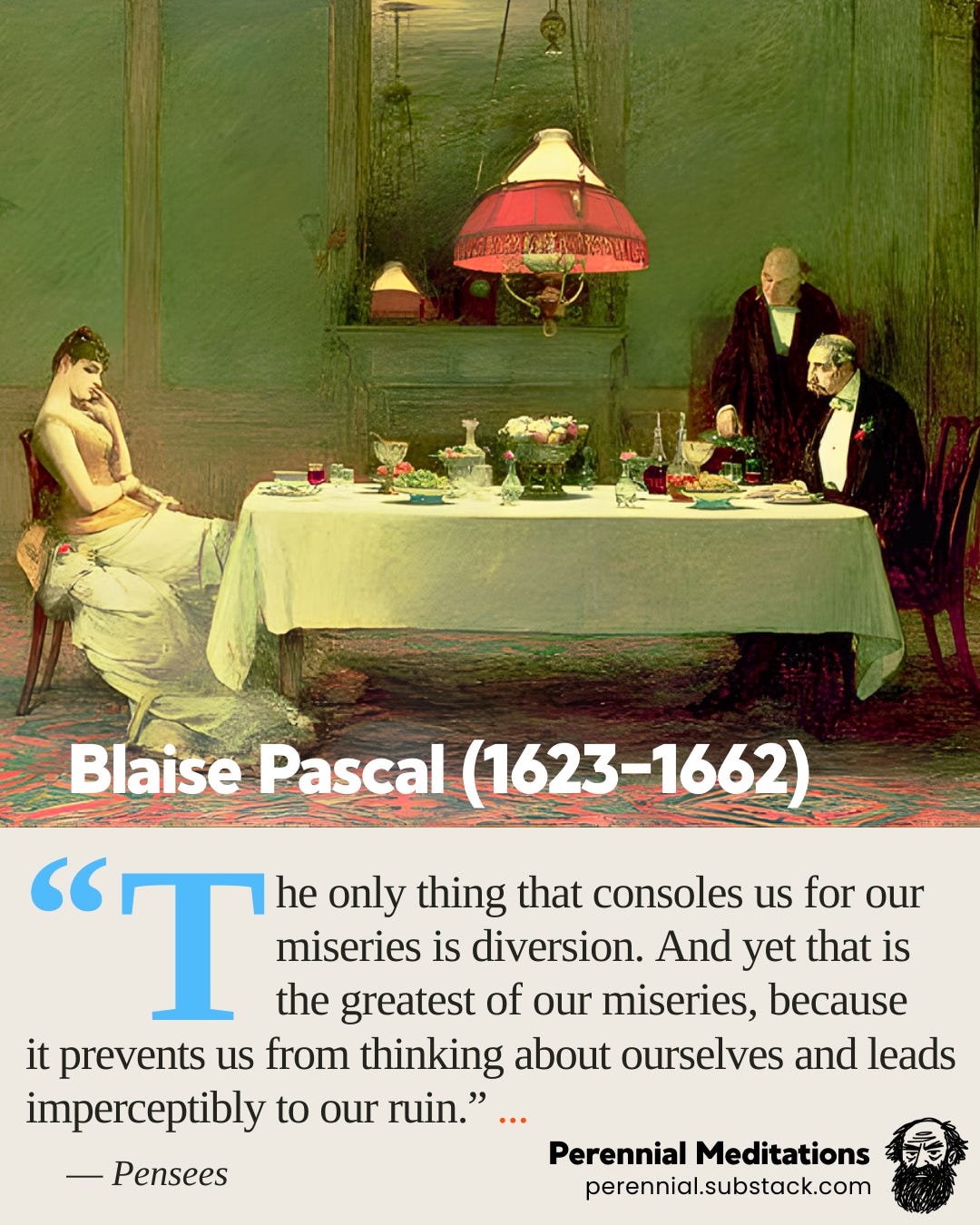
Blaise Pascal (1623–1662) was a French mathematician, physicist, inventor, and Christian philosopher whose work bridged the scientific revolution and the birth of modern existential thought.
Learn more: The Saint’s Guide to Happiness
💡 Perennial Insight(s)
“In the dark night of the soul, bright flows the river of God.”
— St. John of the Cross, The Dark Night of the Soul
St. John of the Cross, a 16th-century Spanish mystic, wrote from a place of deep suffering. Imprisoned in a tiny, cold cell by members of his own religious order, he experienced abandonment not only by people, but seemingly by God.
Out of that anguish came his image of the “dark night of the soul”—a season when old lights go out and familiar consolations vanish.
We often believe that when life feels spiritually or emotionally dark, something has gone terribly wrong.
St. John offers a more paradoxical idea: sometimes, what seems like absence is actually a deeper process of transformation. Old supports are removed so a truer, less self-centered love can develop. It is not punishment but a severe mercy.
Literature and psychology both suggest this pattern. Many stories depict heroes going through a descent before renewal. Therapists refer to “disintegration” stages, when our previous way of understanding life breaks down, allowing a wiser one to emerge. None of this romanticizes pain; it simply acknowledges that growth often requires our usual certainties to fail us.
The dark night is not permanent. But while it continues, St. John invites us to trust—not in the feeling of light, which may disappear—but in the subtle flow of a deeper river beneath everything.
Daily Action
If you’re going through a dark or confusing time, take ten minutes today to write a letter to God, to life, or to your own soul, honestly describing how you feel—without forcing a positive spin. Finish with a simple line of trust or openness: “I don’t understand, but I’m willing to be led.”
Learn more: Making Sense of Emotions
—
Thank you for reading; I hope you found something useful.
Until next time, be wise and be well.
J.W. Bertolotti
P.S. Catch up on recent (and past) meditations in the archive!